Last issue the cap arrived with an engineer's name on it. This fortnight the company that sells the tools stopped arguing and changed a setting. EVP Jay Parikh told Microsoft staff that tokenmaxxing is not what the company optimizes for, divisions picked up AI token budget targets in July, and the default model for internal use became OpenAI's cheaper GPT-5.6. Three moves, and exactly one of them re-prices a request the instant it lands. The budget targets arrived without a figure attached. The memo was never going to carry one. The default did not wait for either.
That ordering is worth carrying through the rest of the issue, because it keeps recurring. XDA moved a single effort dropdown in Claude Code and watched output tokens fall 45% across five jobs that all still finished. NVIDIA shipped routing as an SDK and published both sides of the trade rather than the flattering half — 74% cheaper, roughly six accuracy points, with the frontier tier touched on only 7% of calls. Zeke Hausfather instrumented eight weeks of his own agent use and found that cache reads made up 96% of the total, which relocates the whole optimization problem away from what the model writes and onto what you keep handing it. And for a control case, InfoWorld went back through Meta's Claudeonomics leaderboard — 60.2 trillion tokens inside a month, the top 250 ranked out of an employee base above 85,000 — to describe what a token counter does to the work once someone is scored on it.
What mattered this week
The company selling Copilot rationed it internally first.
Microsoft handed its divisions AI token budget targets in July and, in the same stretch, reset the default model for internal use to OpenAI's cheaper GPT-5.6 — with EVP Jay Parikh telling staff the company is not optimizing for tokenmaxxing. Emanuel Maiberg's reporting for 404 Media places Microsoft in company: Amazon, Adobe, Atlassian and Citi are all already throttling what staff can spend. And it is worth stressing what this is not. Revenue, operating income and profit all landed ahead of Wall Street's expectations in the same period.
Takeaway: Borrow the sequence, not the slogan. Only the model swap changes what a request costs, and it changed it for everyone at once — no meeting, no rollout, no team-by-team negotiation. The budget targets shipped without a number attached, and the memo was never going to have one. The reading that lingers came from an employee who spoke anonymously and treated the whole exercise as a judgment on the economics of the product Microsoft is out selling. Unverifiable, and harder to shake off than the token targets.
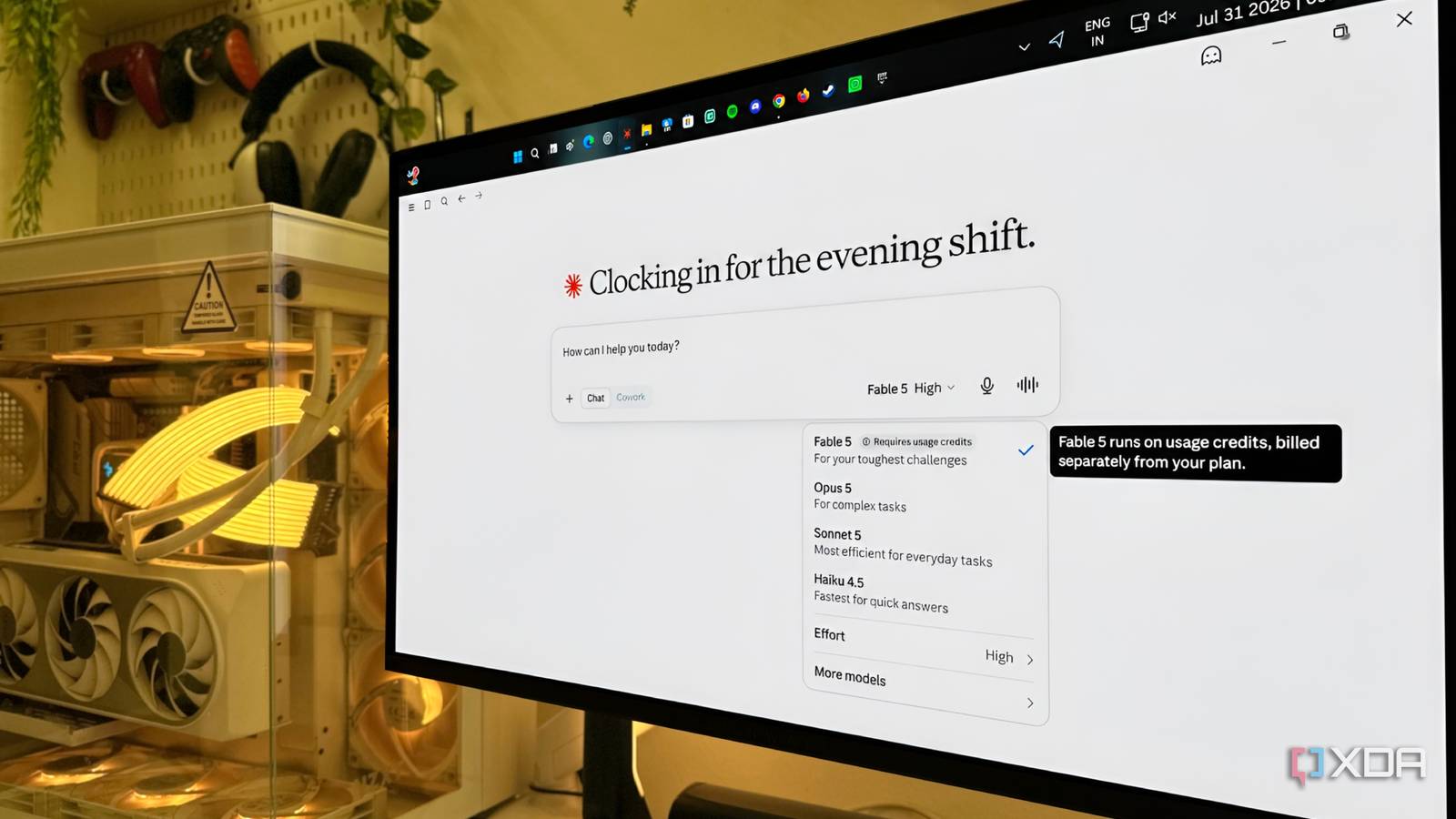
Read source noteOne dropdown, 45% fewer output tokens, all five jobs still done.
Mahnoor Faisal set up five coding jobs at XDA, ran each twice on Sonnet 5 from an identical starting codebase, and varied nothing but the effort setting. The High passes consumed about 26,000 output tokens; the Medium passes closed out the same work on roughly 14,300. Nothing broke at the lower setting — on the bug-fix task the two runs converged completely, each arriving at the same under-tested function, the same defect, and the same single-line patch, with twelve tests passing.
Takeaway: How much comes back scales with how big the job is, which is the routing argument compressed into one model's settings: the smallest task returned a quarter of its tokens (2,000 down to 1,500) while the feature work returned nearly half (14,400 down to 7,500). That argues for Medium as the floor rather than the answer — make a task demonstrate it needs more before it gets more. Caveat it honestly, though: one engineer, one codebase, five tasks. This is a direction, not a benchmark, and rerunning it against your own repo costs less than trusting it.
Read source noteRouting finally published the price of its own accuracy loss.
Switchyard is NVIDIA's provider-agnostic SDK for agent routing: cheap model by default, frontier model only where a step earns the promotion. LangChain ran it over 145 multi-turn agentic tasks. Putting Nemotron 3.5 Lightning underneath Claude Opus 4.8 came in 74% below the cost of staying on the frontier tier the whole way — and NVIDIA prints the roughly six accuracy points that bought, rather than leaving a reader to dig them out. Across LangChain's run, the expensive tier was invoked on just 7% of calls.
Takeaway: Cognition's result is the one to carry into a planning meeting. Running Kimi K2.7 under Opus 5 inside Devin Desktop produced 50.6% on FrontierCode Main at a $3.11 mean cost, surrendering 2.8 points to save roughly 28%. Less dramatic than 74%, and far likelier to survive contact with a real workload. Keep in mind whose blog this is: NVIDIA selected the pairings and its partners ran the evaluations, so every figure is a ceiling. What transfers is structural — keeping the routing decision outside any single model vendor.
Read source note96% of an agent's tokens are just context being re-fed.
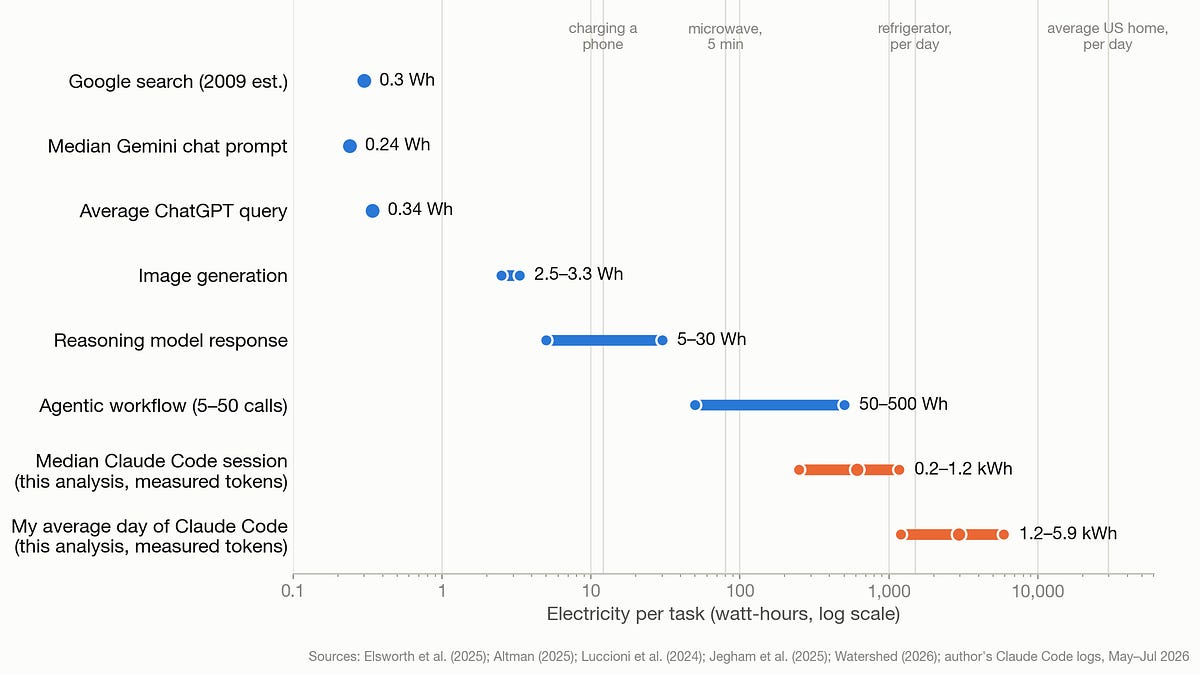
Zeke Hausfather, a climate scientist, instrumented his own Claude Code habit for eight weeks. He typed 1,138 prompts; those fanned out into upwards of 14,000 calls and 3.2 billion tokens, which he works through to around 170 kWh drawn at the data center. The revealing figure is not the total but its composition: cache reads accounted for roughly 96% of the tokens, and output for four tenths of one percent. He then reconciles his session logs against three published estimation methods — a typical session of his lands near 600 Wh and 10 million tokens, where Simon Couch's published median sits at 41 Wh and 592,000 tokens.
Takeaway: If context replay is almost the entire volume, then trimming output is housekeeping on 0.4% of the problem. What actually moves the number is what stays in the window and how cleanly it caches — and the invoice tracks the same curve, since a cache read is priced well below fresh input. The secondary casualty is every AI footprint estimate built on chat: he clocks a single agentic prompt near 150 Wh where a chat turn runs 0.24 to 0.34 Wh, a gap around 600-fold. The per-prompt figures in wide circulation are measuring a different product.
Read source noteThe control case for all of this is Meta's leaderboard.
Matthew Tyson's case is that counting tokens is a worse yardstick than counting lines of code, and Meta's Claudeonomics board is his exhibit: a ranking of the top 250 out of an employee base above 85,000, with 60.2 trillion tokens burned inside a single month. The cost of it is documented rather than implied — outages at Meta traced by its own engineers back to sloppy generated code, Amazon shutting its Kirorank board down within a few weeks, and Uber said to have exhausted a full year of AI budget before Q1 was out.
Takeaway: The scoring runs backwards, and it runs backwards in the expensive direction. Spend an hour reasoning your way to a three-line fix and you barely register; emit 500 lines of generated sludge and you top the table. Since output can carry up to five times the price of input, the board effectively subsidizes whichever habit does the most damage to the bill. Tyson is writing opinion, but he did not invent the damage: a study of some 600 million code changes recorded duplication up 81%, refactoring down 70% against 2022, and early-life churn climbing from 3.3% in 2021 to 7.1% in 2025.
Read source noteThe crown at the top of the rankings is 62.5% free.
For the week running July 27 to August 2, OpenRouter's usage table put DeepSeek V4 Flash on top at 7.22 trillion tokens. The first four positions all belonged to Chinese labs, and two further DeepSeek builds — V4 Flash 0731 and V4 Pro — sat inside the top six. The figure that reframes the table comes from the record day itself: V4 Flash moved 8 trillion tokens through OpenCode on August 1, and 5 trillion of that was free-trial volume against 3 trillion actually billed.
Takeaway: Put subsidized and paid volume in the same column and a ranking stops measuring demand and starts measuring generosity — while defaults quietly settle on whatever sits at the top, generally well before anyone benchmarks it. TechNode, working from Jiemian's reporting, is upfront about the other limit: the totals describe the platforms under observation, not DeepSeek's global footprint. Read position as a proxy for price sensitivity and stop there.
Read source noteWhere the next move is
The frontier tier came back to a board it had vanished from.
Our snapshot, pulled this morning and covering OpenRouter's rankings through August 16. A fortnight ago there was no Anthropic model and no Google model anywhere in the top twelve, which we wrote up as a clean story about price-sensitive routing. Today Claude Opus 5 sits third at about 793 billion tokens for the day and Gemini 3.6 Flash ninth at 501 billion, and the Chinese share of the top twelve has slipped from nine of twelve to seven. DeepSeek V4 Flash still leads at 1.46 trillion, with Tencent's Hy3 behind it at 1.06 trillion. Before anyone reads a comeback into that, the daily and thirty-day columns disagree: across the trailing month Hy3 leads at 31.7 trillion and Xiaomi's Mimo V2.5 follows at 28.4 trillion, while Opus 5's 5.13 trillion for the month is barely a fifth of what its current daily rate would project. The day is showing a ramp, not a position. And the board's blind spot has not moved: it counts only what was routed through OpenRouter to begin with. Copilot seats, Claude Code sessions, direct API traffic — the spending this entire issue is about — never appear on it.
- Pricing did not converge to explain this. DeepSeek V4 Flash still lists around $0.08 per million tokens of input where Claude Opus 5 asks $5. The gap held and the traffic moved anyway.
- Check a model's daily figure against its own thirty-day total before calling anything a trend. Opus 5 and Gemini 3.6 Flash both look far stronger on the day than across the month, which is what a ramp looks like rather than a shift in share.
- Free tiers are pooled with paid traffic in this table, so treat rank as a census of price-sensitive routing and never as revenue or market share.
Quota anxiety now ships as hardware.
The tooling with real pull still sorts into two piles: the things that spend on your behalf — LiteLLM at 56.5k stars, LlamaIndex at 51.7k, LangGraph at 39.9k, Qdrant at 34k — and the things that account for it afterwards, where DSPy sits at 37.3k, Langfuse at 33.2k, promptfoo at 24.3k and tiktoken at 19k. This fortnight the accounting pile acquired a physical object. Fractal Manifold is crowdfunding a €99 ESP32-S3 desk display whose entire purpose is to sit beside you reporting what fraction of the allowance has burned, how long until it refills, and what the tokens cost — across three separate agent CLIs: Claude Code, Codex and Antigravity. The assumption baked into that spec sheet is that you are running all three and watching three clocks at once.
- Once someone can sell you a screen whose only job is a reset timer, per-session limits have stopped being an irritation and become something teams schedule around.
- Given the 96% cache-read figure above, the first counter worth building is cache hit rate. Token totals are the easy number to collect, not the one that explains an invoice.
- Crowdfunded hardware makes November 2026 a promise rather than a date. The lasting signal is which four numbers it judged worth the screen space.
Turn the dial before you write the policy.
There is a running order hiding in this issue, and most teams attempt it backwards. Start with the settings that cost nothing to try: drop your agent's default effort one notch and measure completion rather than comfort, because XDA's five jobs all finished at Medium for 45% fewer output tokens. Then change the default model instead of the culture, which is the only one of Microsoft's three moves that re-priced anything on the day it shipped. Then instrument context, because if 96% of your tokens are cache reads then the entire optimization surface is what stays in the window and whether it caches cleanly. Routing comes fourth, and only with both halves of the number written down — Switchyard's 74% cut arrived with roughly six accuracy points attached, and Cognition's more modest 28% with 2.8.
- Rank your levers by what they cost to test. An effort dropdown costs an afternoon; a router costs a quarter, and it should have to beat the dropdown first.
- Track cache reads and turns beside tokens. Output is close to a rounding error in agent workloads, and savings that come back as retries land in a column nobody is watching.
- Any routing claim quoted without its accuracy cost is half a number. Ask what it lost, then decide whether your workload can afford to pay it.
Our best-ranking page has never been clicked.
Live from Search Console through August 14, and the sharpest cell on our own board is an embarrassing one. The query "tokenmaxxing" lands the /guides hub at position 3.8 — the best average rank we hold anywhere on the site — across 3,557 impressions, and it has produced zero clicks. Not a poor rate; zero. The leaderboard page is barely better on the identical query at position 4.0, 3,530 impressions, two clicks. Meanwhile the two-word variant "token maxing" pulls 125 clicks from 7,092 impressions on the homepage at position 5.0, a 1.76% rate that is roughly four times anything the one-word spelling manages anywhere. The pages that rank best are the pages nobody opens, and the spelling we rank worse for is the one that actually converts.
- Top structural move this fortnight: rewrite title and meta for the /guides hub and /leaderboard on the head term. Rank 3.8 with zero clicks is a title problem, not a ranking problem.
- The definition-query finding from the last two issues still holds — the guide converts 1.05% at position 6.0 against the homepage's 0.46% at 6.1 — and it is still unshipped, which now makes it three issues of watching rather than fixing.
- Impressions here sit on a rolling ninety-day window, so read the rates and average positions across issues and leave the raw impression totals alone.
Read the token-spend tracking guide
Every lever in this issue rests on a figure you can rebuild from your own logs — effort level, default model, cache hit rate, cost per finished task. Here is how to assemble one, so the next 74% claim has to get past your instrumentation instead of your goodwill.
Continue reading